| | 5 minute read

Selon un rapport, la Chine demanderait à des entreprises sud-coréennes de suspendre leurs exportations vers des entreprises américaines du secteur de la défense

This week, China urged South Korean companies to halt exports of products containing Chinese rare earth elements to US defense firms, according to the Korea Economic Daily. This follows China's export restrictions on several rare earth elements, including dysprosium, terbium and NdFeB magnets containing those elements, announced on April 4, 2025, amid escalating US-China trade tensions and new US tariffs.

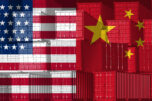
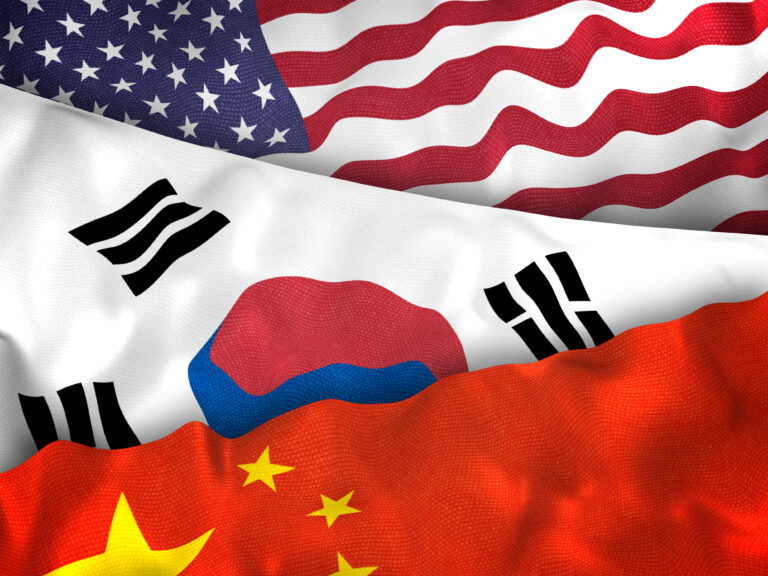
Illustration showing flags of usa, south korea, and china, symbolizing east asian diplomacy, military alliances, and complex regional relationships.

“As of yet, no facts have been confirmed”

This week, China urged South Korean companies to halt exports of products containing Chinese rare earth elements to US defense firms, according to the Korea Economic Daily.

This follows China’s export restrictions on several rare earth elements, including dysprosium, terbium and NdFeB magnets containing those elements, announced on April 4, 2025, amid escalating US-China trade tensions and new US tariffs.

The Chinese government reportedly sent letters to South Korean manufacturers in battery, electric vehicle, aerospace and other industries, warning of sanctions for non-compliance.

South Korea’s Ministry of Trade, Industry and Energy said Wednesday, “as of yet, no facts have been confirmed” and that it “is in the process of checking whether the news article is based on facts by communicating with the Chinese government and relevant industries”.

South Korean officials are in Washington this week to discuss tariffs with their US counterparts, Reuters reported.

Earlier this month, Korea’s industry ministry said the country “maintains over six months’ worth of public reserves for metals like dysprosium”, the Korea Herald published.

South Korea’s first NdFeB factory

South Korea’s first NdFeB magnet factory opened its doors in October 2023 and counts Hyundai, LG Innotek, Valeo, Posco, Vinfast, Seagate and Western Digital among its clients and partners.

Owned by Sunglim Advanced Industrial, a subsidiary of Star Group, the factory has capacity to produce 1,000 tonnes of NdFeB magnets per annum, including dysprosium- and terbium-diffused magnets, as well as cerium-containing magnets.

In 2021, LG Innotek announced development of a super-strong “eco-friendly” NdFeB magnet with Sunglim that contains 60% less heavy rare earths than competitors’ products.

In late-2024, LG Innotek announced that it developed a heavy rare earth element (HREE) free variant of its “eco-friendly” magnet with the Korea Institute of Materials Science that can operate at temperatures up to 180℃ – a potential alternative to restricted magnets from China.

Similarly, industry leader Neo Performance Materials produces a line of ultra-fine grained “MQU” NdFeB powders – an order-of-magnitude finer grained than those found in conventional sintered NdFeB magnets – that can be used to produce “MQ3” HREE-free NdFeB magnets suitable for EV motors, robot actuators and other high performance applications – another potential alternative to restricted magnets from China.

Largest importer of dysprosium oxide in 2025 YTD

While the South Korean government fact checks the allegations, we observe that they have materialized at an interesting time.

Not only is South Korea host to magnet production capacity that could partially supply the US defense industry amidst China’s export restrictions, the nation has also become a major importer of China’s dysprosium (and terbium) in recent years, reinforcing the assertion that it holds considerable reserves of the material that could be used against China’s interests.

In fact, through the first three months of 2025, customs data indicates that South Korea imported more dysprosium oxide from China than any other nation, including Japan, and over the same three-month period imported more dysprosium oxide than it did in all of calendar 2024.

It begs the question – has South Korea’s import surge raised red flags in China? Or is it merely a continuation of its volatile import history, that has seen volumes swing from year to year. As we noted in February, China is implementing a rare earth traceability system that will allow it to oversee and manage exports with surgical precision. Are we now seeing this oversight in action?

Isolated incident?

Relative to Japan – the leading producer of NdFeB magnets outside China, and the leading importer of dysprosium oxide from China –  South Korea is a relatively small player leading us to question if incumbents in Japan, or even Japanese companies operating in China, have received similar alleged letters or threats of sanctions.

Same for the Philippines, the third largest importer of dysprosium oxide, which, like South Korea, imported more of the material through the first three months of 2025 than all of 2024 combined, but also has a somewhat volatile import history.

With the trade war evolving by the week, time will tell how the situation evolves.

If the latest allegations prove true, it signals a sincere fervor in China’s intent to cut off access to US defense and leaves little doubt that any export license applications for US defense-related entities will ultimately be rejected, possibly following an intentionally drawn-out review period.

Rencontrer d'autres fournisseurs

Rencontrez des exploitants miniers spécialisés dans les terres rares alternatives et des fabricants d'aimants à Toronto en septembre 2025, à l'occasion du salon « Rare Earth Mines, Magnets & Motors 2025 », où nous approfondirons ce sujet avec les principaux acteurs du marché et des experts du secteur.

Cet événement de deux jours réunira des responsables commerciaux et techniques issus de l'ensemble de la chaîne d'approvisionnement mondiale, de l'exploitation minière aux équipementiers, pour des échanges de haut niveau et des occasions de réseautage dans un établissement 5 étoiles.

Parmi les thèmes phares de la conférence de cette année figureront la robotique, l'automatisation, la mobilité aérienne avancée, ainsi que la chaîne d'approvisionnement émergente « de la mine à l'aimant », qui se développe en amont.

Invité spécial : Steve Wozniak, cofondateur d'Apple

Pour plus d'informations : www.adamasevent.com

Rem3 2025 avec Woz v3

Retour à Adamas Inside
Ce contenu est réservé aux membres Adamas Insiders

Rejoignez Adamas Inside et bénéficiez d'un accès gratuit à des analyses, des études et des données exclusives

  • Véhicules électriques, batteries et matériaux pour batteries
  • Moteurs, aimants et terres rares
  • Prix, politique, commerce et plus encore
Inscription gratuite
Rejoignez Adamas Inside
8