Top 5 EV models globally by battery nickel deployed

The batteries of EVs, including plug-in and conventional hybrids, sold over the first eight months of the year contained 221.4 kilotonnes of nickel, a 12% increase from the same period in 2024.
Nickel deployment growth for the period fell well short of the overall rate for battery capacity deployment, which totaled 648.5 GWh, a 28% expansion, and new EV registrations, which rose by 25% to just under 18 million.
The underperformance was mostly the result of Chinese automakers’ continued preference for LFP batteries and lingering use of low-nickel NCM packs, which have seen total deployment growth drift lower.
Tesla’s workhorses led the pack with the Tesla’s Model Y way out in front with 21.4 kt deployed and the Model 3 at 5.7 kt.
While the total deployed nickel tonnage in Model Ys was down 8% year on year, the Model 3 eked out a 1% gain. The performance of the Model Y was negatively impacted by declining sales of the higher end variants in China, which are equipped with high-nickel NCM batteries.
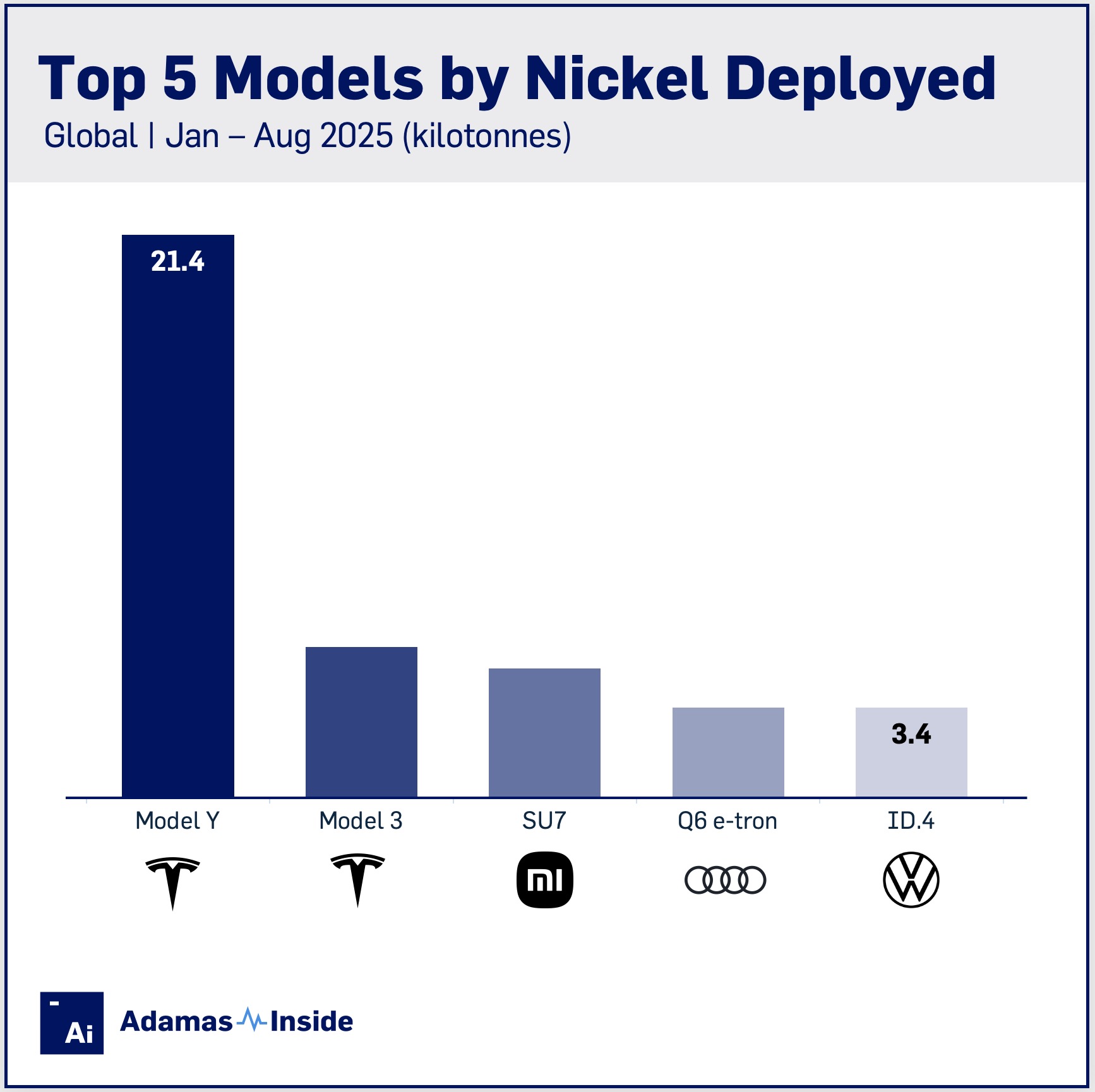
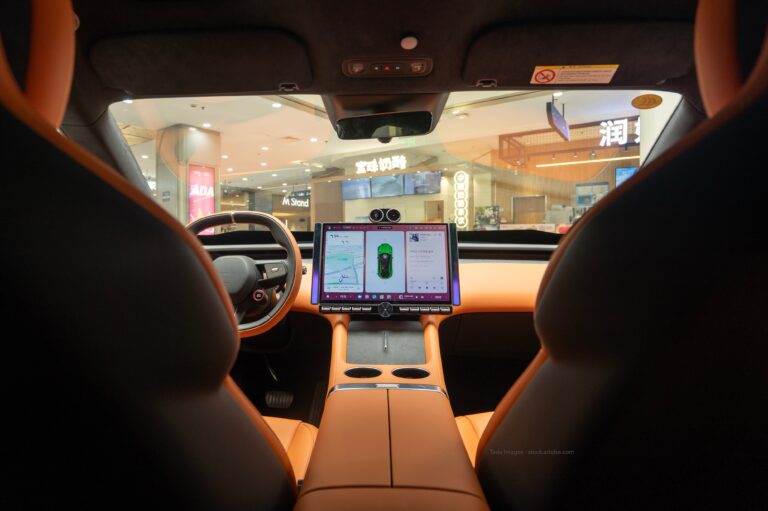
Tesla faces stiff competition in China from the likes of Xiaomi, which placed third with its SU7 sports sedan at 4.9 kt. The Xiaomi YU7 (pictured), a purported Model Y killer, went on sale during the summer and would no-doubt start appearing on leaderboards before the end of the year.
Another newer model, the Audi Q6 e-tron, occupied fourth place, with 3.4 kt of battery nickel deployed so far this year, despite not being available in China.
The Q6’s more downmarket stablemate, the Volkswagen ID.4, rounds out the top five just ahead of the Chevrolet Equinox. The batteries of ID.4s sold since January contained 3.4 kt of nickel, 17% more than in 2024. A respectable performance for the C-segment SUV, given how long it has been on the market and with a major refresh coming only next year.
Nickel prices have held up well this year, with battery-grade sulphate entering the EV supply chain in China up by double-digit percentage points to average $3,856 a tonne in September.
Tesla was the world’s biggest spender on EV battery nickel for the first eight months of the year, at $488.7 million (based on installed tonnes multiplied by average monthly prices).
Volkswagen and Audi spent a combined $331.8 million while Xiaomi’s outlays were $87.6 million. Tesla’s nickel expenditure made up 48% of the automaker’s total battery metal spending.
For VW-Audi that number came to 51% while Xiaomi’s nickel tab was 38% of the total, a reflection of the latter’s larger proportion of LFP battery powered models shipped.
Contact the Adamas team to learn more or check out the intelligence services below.