First US humanoid pure-play IPO readiesd, Germany’s NEURA raises $1.4B and Beijing wires rare earths into the robot chain
In June, Agility Robotics agreed a $2.5bn listing, NEURA raised up to $1.4bn, and AGIBOT passed 15,000 humanoids, while Chinese officials moved to wire rare earth supply into the robot chain—hardening robotics as the defining magnet-demand story of the coming decade.
Capital markets open to humanoids
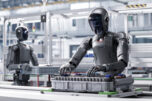
Agility Robotics announced a $2.5 billion business combination with Churchill Capital Corp XI on June 24th, raising more than $620 million in gross proceeds ($420 million from Churchill’s trust plus a roughly $200 million Foxconn-led PIPE) to list as the first U.S. pure-play humanoid company. Agility’s Digit robots already handle material flows at Toyota’s Woodstock, Ontario plant under a robots-as-a-service contract.
Two weeks earlier, Germany’s NEURA Robotics announced Europe’s largest humanoid financing – a Series C of up to $1.4 billion at a reported $7 billion valuation, led by Tether alongside Qualcomm, Amazon, NVIDIA, Bosch, Schaeffler and the European Investment Bank – to scale toward multi-million-unit serial production by 2030 against an order book above $1 billion.
Production is scaling fast. AGIBOT’s 15,000th G2 industrial humanoid rolled off the line on June 28, with the climb from 5,000 to 10,000 units taking roughly three months, four times the prior pace; the Shanghai company shipped 5,168 units in 2025 for a 39% global share.
Tesla built its last Model S and X at Fremont in early May and is converting the line to Optimus Gen 3 designed for up to 1 million units a year, with initial production targeted for late July or August. Figure AI’s BotQ factory hit one Figure 03 per hour in May, and its fleet passed 750 units in June – more than the company’s human headcount. UBTECH’s Walker S2 targets 5,000 industrial units a year on confirmed orders above $195 million, and XPeng’s IRON is heading for mass production before year-end.
Le bulletin mensuel du marché des terres rares
Évaluations des prix des oxydes, des métaux et du NdFeB, analyses de marché et données
Automotive OEMs are moving from pilot to scaled deployment. BMW put Figure 03 to work on logistics sequencing at Spartanburg on June 26th, after Figure 02 logged 1,250 hours and moved more than 90,000 parts over an 11-month run. Boston Dynamics’ electric Atlas has its entire 2026 production committed to Hyundai’s Metaplant robotics center in Georgia and Google DeepMind with a dedicated Atlas factory targeted for 2028.
BYD confirmed its own program in early June: reported plans put up to 20,000 units in its own plants by end-2026 and a Xi’an industrial park scaled toward 50,000 units a year, with BYD itself the largest customer, though the company has pushed back on the 2026 timing. Infineon and Vingroup’s VinRobotics signed an MOU on June 9 to co-develop humanoids from a joint center in Hanoi.
China to formalize rare earth miner to humanoid OEM coordination
On June 16th, senior China Rare Earth Industry Association officials met the Beijing Humanoid Robot Innovation Center, Tongzhou District government and China Iron & Steel Research Institute researchers, with technical sessions on robotic joint modules – high-torque NdFeB motors, NdPr and heavy rare earth grades, miniaturization and durability thresholds. The parties agreed to formalize a standing, government-backed coordination mechanism spanning rare earth miner to humanoid OEM. Separately, on June 5 Pangoo Power and the Chinese Academy of Sciences’ Ningbo Institute of Materials Technology and Engineering unveiled an axial flux motor built on a dedicated permanent magnet material: 18,000 rpm, 25.73 kW/kg power density and 293 Nm/kg torque density, 22% above benchmark, with no NdFeB grade or Dy/Tb loading disclosed.
L'avis d'Adamas :
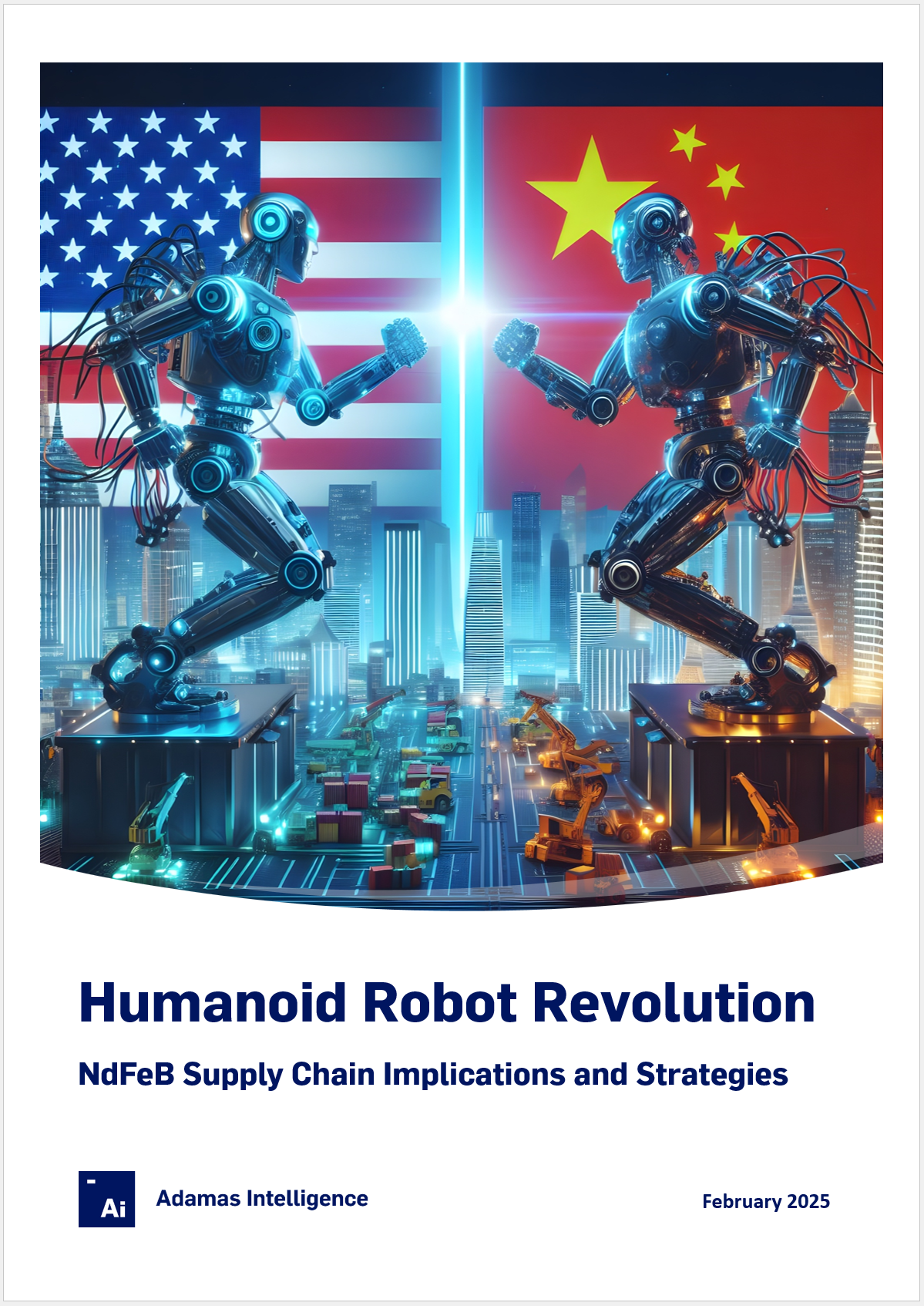
Recent updates support our views that robotics is the defining rare earth demand story of the next fifteen years. We forecast robotics NdFeB demand growing at a nearly 28% CAGR through 2040 (Rare Earth Magnet Market Outlook to 2040 report). Combined, robotics, e-mobility and advanced air mobility will be responsible for nearly 60% of the NdFeB demand in 2040. Assuming 30-40 degrees of freedom per professional service humanoid robot, every 10,000 units consume over 30 tonnes of NdFeB magnets. The OEM programs now on the table have the potential to drive a nearly four-figure-tonne annual NdFeB demand stream by 2028, from a segment that barely existed in 2024.
The CREIA mechanism formalizes the miner-to-OEM interface before volumes turn commercially significant – the solar-panel playbook applied to magnets. Watch whether CREIA yields robot-specific NdFeB specifications or offtake frameworks.
Contactez-nous dès aujourd'hui pour en savoir plus sur nos services d'analyse de marché des terres rares, leaders du secteur.