15 MW magnet-class turbines are scaling in Europe, Japan as US erases 7.2 GW of offshore wind
Despite near-term headwinds in Europe and North America, the wind industry remains a structural NdFeB consumer. The sector’s magnet demand is expected to grow below the global NdFeB average through 2040, as the growth torch is passed to robotics, passenger EVs and advanced air mobility
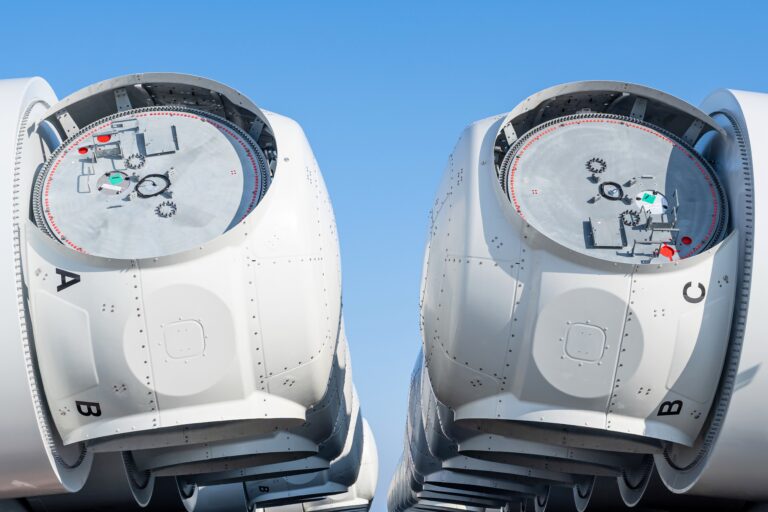
Vestas surpassed 100 installations of its 15 MW turbines at sea in June, a global fleet milestone the OEM reached as construction advances at the 1.2 GW Baltic Power project off Poland – the country’s first offshore wind farm, taking 76 of the machines and due to commission in H2 2026. The hundred units – roughly 1.5 GW within about 18 months of serial production – confirm the 15 MW direct-drive class, its permanent magnet generator carrying roughly 3 tonnes of rare earth material per turbine, as the workhorse of the European offshore buildout.
The order book is firming. RWE has signed supply agreements for 184 of the machines across its 2.76 GW Norfolk Vanguard West and East projects in the UK, with a combined FID targeted for summer 2026 and commissioning in 2029–2030. In Germany, Skyborn’s 976.5 MW Gennaker project (63 Siemens Gamesa 14 MW direct-drive turbines) heads for its own summer FID with €700 million ($760 million) of EIB backing and a 600 MW Amazon power purchase agreement, Germany’s largest single PPA.
The class also cleared its first Asia-Pacific beachhead: DEME’s Japan Offshore Marine joint venture with Penta-Ocean won a contract worth up to €50 million ($58 million) to install 21 of the Vestas machines at the 315 MW Oga-Katagami-Akita project, Japan’s first 15 MW-class deployment and the first for the turbine outside Europe, with offshore installation from 2027.
Monatsbericht zum Markt für Seltene Erden
Preisbewertungen, Marktanalysen und Daten zu Oxiden, Metallen und NdFeB
Washington pays $765 million to terminate offshore leases
The United States is moving the other way. Interior agreed on June 17th to pay Invenergy $765 million to terminate four leases in the New York Bight, off central California and in the Gulf of Maine, removing roughly 7.2 GW of potential capacity; federal buyouts now total eight deals worth about $2.5 billion since January, with proceeds redirected to gas and geothermal.
California filed notice to sue over the parallel $120 million Golden State Wind buyout, but litigation offers the pipeline no near-term reprieve.
Siemens Gamesa warned that stalled European expansion (the EU is running some 40 GW short of its 120 GW 2030 target) could force factory downsizing starting in 2028. Onshore, Pattern Energy’s 3,650 MW SunZia, the western hemisphere’s largest wind farm, began commercial delivery in New Mexico on June 18th. Its 916 geared units – 674 GE Vernova machines fitted with induction generators and 242 mid-size Vestas turbines – carry only modest magnet content, however.
Adamas' Meinung:
June’s offshore updates consolidated around two clear poles: Europe and Japan. Oga-Katagami-Akita is the first proof point that European-class PMDD machines can anchor Asia-Pacific buildout outside China, where we see end-use demand compounding at 15% annually, the fastest of any region (Rare Earth Magnet Market Outlook to 2040 report).
Despite near-term headwinds in Europe and North America, the wind industry remains a structural NdFeB consumer. The sector’s magnet demand is expected to grow below the global NdFeB average through 2040, as the growth torch is passed to robotics, passenger EVs and advanced air mobility
Key developments to monitor in summer 2026 include the FID window for Vanguard and Gennaker (~3.7 GW combined) and Siemens Gamesa’s order intake. A second OEM warning would point to near-term downside risks for European magnet demand.
Kontaktieren Sie uns noch heute, um mehr über unsere branchenführenden Marktanalysen für Seltene Erden zu erfahren.