Musk on rare earth export restrictions: Optimus was affected
In Tesla’s Q1 2025 earnings call this week, Elon Musk revealed a critical hurdle for the production of Optimus, Tesla’s humanoid robot: China’s export restrictions on rare earth magnets. Musk stated, “Optimus was affected… by the magnet issue from China because the Optimus actuators in the arm do use permanent magnets,” highlighting how China’s export restrictions, imposed in early April 2025, are poised to disrupt Tesla’s supply chain.
Production bottleneck
In Tesla’s Q1 2025 earnings call this week, Elon Musk revealed a critical hurdle for the production of Optimus, Tesla’s humanoid robot: China’s export restrictions on rare earth magnets.
Musk stated, “Optimus was affected… by the magnet issue from China because the Optimus actuators in the arm do use permanent magnets,” highlighting how China’s export restrictions, imposed in early April 2025, are poised to disrupt Tesla’s supply chain.
China’s new controls, a response to US tariffs, target seven rare earth elements (REEs) and magnets that contain them, requiring exporters to first secure licenses – a process Musk noted involves assuring Beijing the magnets are for civilian, not military, use.
This bottleneck threatens Tesla’s ambitious goal of producing thousands of Optimus units by year-end, casting uncertainty over the near-term rollout and sending ripples through the broader humanoid robotics industry.
Magnets for compact, high-torque motors
Musk’s comments underscore the critical role of rare earth magnets, particularly neodymium-iron-boron (NdFeB) varieties, in Optimus’ design. These magnets, often containing dysprosium and/or terbium for high temperature stability, enable compact, high-torque motors essential for the robot’s numerous actuators.
Musk’s specific reference to Optimus arm actuators is curious since it is widely believed that Optimus, at least Gen 1 and 2, uses permanent magnet motors throughout.
In reality, it could be that the arm actuators use NdFeB magnets containing dysprosium and/or terbium (and hence are restricted) while the other actuators do not, thus didn’t get a mention.
Alternatively, it could be that Optimus Gen 3 – the production version – does incorporate alternative motor types, or simply that Musk misspoke.
No guaranteed timeline
The Tesla founder explained, “When something is volume constrained, like an arm of the robot, then you want to try to make the motors as small as possible,” revealing why Tesla opted for these specialized magnets despite exploring alternative sourcing for years.
The export curbs, which halted shipments at many Chinese ports, have left Tesla navigating an opaque licensing process that could take weeks to months, with no guaranteed timeline.
While Musk remains optimistic about securing licenses, the delay risks pushing back Optimus’ internal deployment in Tesla’s Gigafactories, where 1,200 units were projected for 2025 testing.
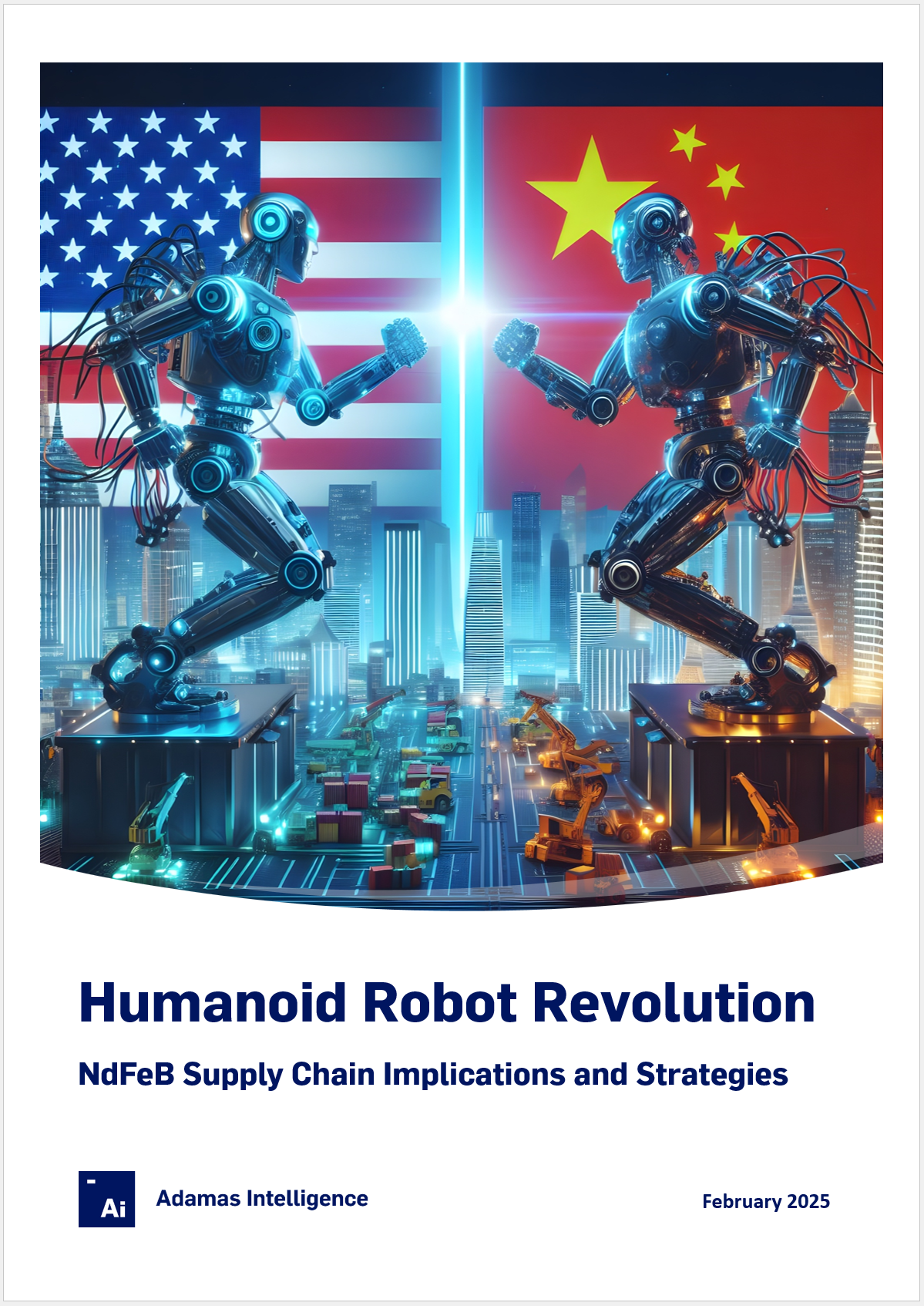
The impact extends beyond Tesla, as China dominates 90% of global magnet production. Adamas Intelligence, in a March 2025 analysis, projects the US humanoid robot market to grow from 3,200 units in 2025 to 36,700 by 2027, with Tesla potentially capturing nearly half the market through its EV-style mass production and cost leadership.
However, Adamas warned that supply chain stability is critical, noting that “permanent magnet and other material shortages” could derail this growth.

Delays could cede ground to Chinese rivals
The current restrictions amplify this risk, affecting competitors like Agility Robotics, Figure and Boston Dynamics, who also rely on similar magnets for their robots’ actuators.
Chinese manufacturers like Agibot, aiming to produce 5,000 units in 2025, face less disruption due to domestic access but could still encounter export challenges for global markets.
In the near term, Tesla’s ability to resolve the licensing issue will determine whether it meets its 2025 targets. Musk’s assurance that the magnets are “just going into a humanoid robot” and not a weapon system may expedite approvals, but geopolitical tensions could prolong delays.
Competitors may seek alternative suppliers, though Adamas notes that scaled non-Chinese magnet production is years away, leaving the industry vulnerable. For Tesla, delays could cede ground to rivals like China’s Unitree, which is already deploying robots in factories, or Agibot, leveraging local supply chains.
Looking ahead, the restrictions highlight the fragility of global supply chains for advanced robotics. Adamas emphasizes that for the industry to achieve its projected tenfold growth by 2027, prices must drop, use cases must prove viable, and supply chains must stabilize.
Tesla’s vertical integration offers some resilience, but the broader sector faces a wake-up call to diversify sourcing. In the coming months, expect Tesla to push aggressively for licenses while exploring magnet alternatives, though Musk’s confidence in producing thousands of Optimus units by year-end may hinge on diplomatic breakthroughs.
For the humanoid robotics race, China’s grip on rare earths remains a formidable gatekeeper, shaping who leads and who lags in this transformative industry.
How much NdFeB does Optimus need?
Assuming Optimus uses permanent magnet actuators throughout, production of 2,000 robots this year would require single-digit tonnes of NdFeB magnets containing mere kilograms of dysprosium and/or terbium.
As such, while China’s export restrictions may present a bottleneck for Tesla in the near-term, by this time next year, or even this time next quarter, it could have a handful of qualified alternative magnet makers outside of China, ready to support its growth.
다른 공급업체와 만나다
2025년 9월 토론토에서 열리는 ‘Rare Earth Mines, Magnets & Motors 2025’ 행사에 참석하여 대체 희토류 채굴업체 및 자석 제조업체 관계자들을 만나보시기 바랍니다. 이 행사에서는 주요 시장 참여자 및 업계 전문가들과 함께 이 주제를 심도 있게 논의할 예정입니다.
이틀간 진행되는 이번 행사에는 전 세계 광산에서 OEM에 이르는 공급망 전반의 비즈니스 및 기술 리더들이 한자리에 모여 5성급 호텔에서 수준 높은 토론과 네트워킹의 기회를 가질 예정입니다.
올해 컨퍼런스의 주요 주제는 로봇공학, 자동화, 첨단 항공 이동성, 그리고 상류 단계에서 통합되고 있는 신흥 ‘광산에서 자석까지’ 공급망 등이 될 것입니다.
특별 게스트: 애플의 공동 창업자 스티브 워즈니악
자세한 정보: www.adamasevent.com