The fallacy of European rare earth prices

Over the past 12 months, price bifurcation in China combined with the emergence of price floors outside China combined with astronomically high prices quoted by intermediates in Europe have amplified confusion about actual prevailing price levels for several critical rare earth elements. This confusion is compounded by Price Reporting Agencies that misrepresent outlier price levels from intermediates as mainstream when underlying trade volumes are negligible.

What’s the real price?
Over the past 12 months, price bifurcation in China combined with the emergence of price floors outside China combined with astronomically high prices quoted by intermediates in Europe have amplified confusion about actual prevailing price levels for several critical rare earth elements.
This confusion is compounded by Price Reporting Agencies that misrepresent outlier price levels from intermediates as mainstream despite underlying trade volumes being negligible.
In at least one case, these outlier price levels – which are several multiples higher than actual volume-backed market prices – were provided by an IOSCO-assured consultancy for use in a Definitive Feasibility Study calling into question both the expertise of the firm in question and the merits of the IOSCO certification itself.

Yttrium oxide:
Adamas Intelligence research shows that approximately 75% of all yttrium oxide consumed globally last year was priced at an average of $6.50/kg, nearly 25% was consumed at an average price of $10.50/kg, and less than 1% was priced at $150/kg or greater, despite the ask-price topping $350/kg in Rotterdam in December 2025.
Dysprosium oxide:
Similarly, Adamas Intelligence research shows that approximately 96% of all dysprosium oxide consumed globally last year was priced at an average of $224/kg, nearly 4% was consumed at an average price of $233/kg, and less than 1% was priced at $800/kg or greater, despite the ask-price surpassing $1,100/kg in Rotterdam in December 2025.
Terbium oxide:
Moreover, Adamas Intelligence research shows that approximately 95% of all terbium oxide consumed globally last year was priced at an average of $936/kg, nearly 5% was consumed at an average price of $995/kg, and less than 1% was priced at $3,350/kg or greater, despite the ask-price exceeding $4,500/kg in Rotterdam in December 2025.
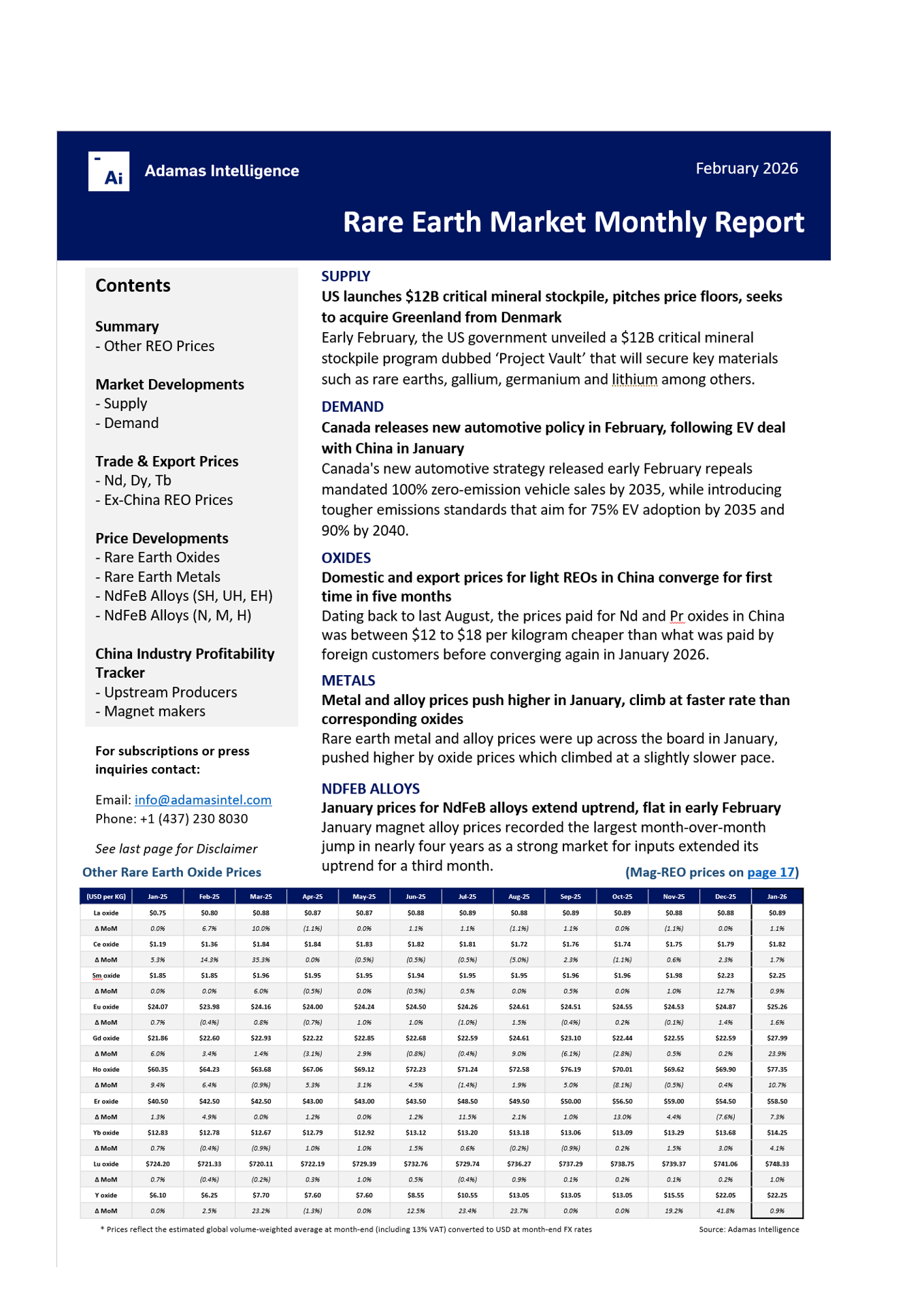
Rare Earth Market Monthly
Oxide, metal and NdFeB price assessments, market analysis and data
Going forward
Outside of China, there is currently an acute need for alternative sources of yttrium, dysprosium and terbium, boding well for strong volume-backed market prices in the near-term.
However, in the case of yttrium oxide, demand outside of China could be saturated by just one or two modest sized heavy rare earth producers, underpinning our expectation that the price of yttrium oxide outside China will be dramatically lower than current Rotterdam levels over the medium- to long-term.
In the case of dysprosium and terbium oxide, demand outside of China is less likely to be saturated by just one or two producers in the foreseeable future, leading us to expect prices outside China will be considerably higher than current levels over the medium- to long-term, albeit also substantially lower than current Rotterdam levels.
Key takeaway
Identifying prevailing price levels requires an understanding of underlying trade volumes, trade terms, product specifications and other critical considerations.
For over 13 years, our intelligence services have helped leading OEMs, rare earth producers, developers and other stakeholders cut through the hype and misinformation commonly found in industry reporting and mainstream media.
Contact us today to learn more about Price Assessment and Price Forecasting services.