Is Myanmar’s military government planning airstrikes on rare earth mines?

As reported to clients in our latest Rare Earth Market Monthly report, at the end of February, a potential supply-side shock emerged with China closing border crossings with Myanmar in Pang War, Kachin State. This action stems from escalating tensions and conflict in northern Myanmar, where the Kachin Independence Army (KIA) controls key rare earth mining areas.

Workers dig bomb shelters, raise Chinese flags
As reported to clients in our latest Rare Earth Market Monthly report, at the end of February, a potential supply-side shock emerged with China closing border crossings with Myanmar in Pang War, Kachin State. This action stems from escalating tensions and conflict in northern Myanmar, where the Kachin Independence Army (KIA) controls key rare earth mining areas.
As of March 4th, Kachin News Group reported that mining companies have hoisted Chinese flags at mine sites in the town where important rare earth mining operations exist so they can be identified from a fighter jet’s cockpit in the event of junta airstrikes.
According to the news agency, “reports that the junta had been planning airstrikes on rare earth mining sites in Pang War began emerging on February 22. Chinese businessmen subsequently instructed workers to dig bomb shelters in advance, and Chinese flags were raised on February 26.”
Border closures have historically been used by China as leverage – often to pressure ethnic armed groups for ceasefires, to halt smuggling, or secure mining concessions amid environmental concerns and instability.
Recent closures appear tied to ongoing clashes, including the February 20th drone attack on a Myanmar National Airlines passenger plane at Myitkyina Airport that prompted intensified junta airstrikes in KIA-controlled areas, including near the Chinese border.
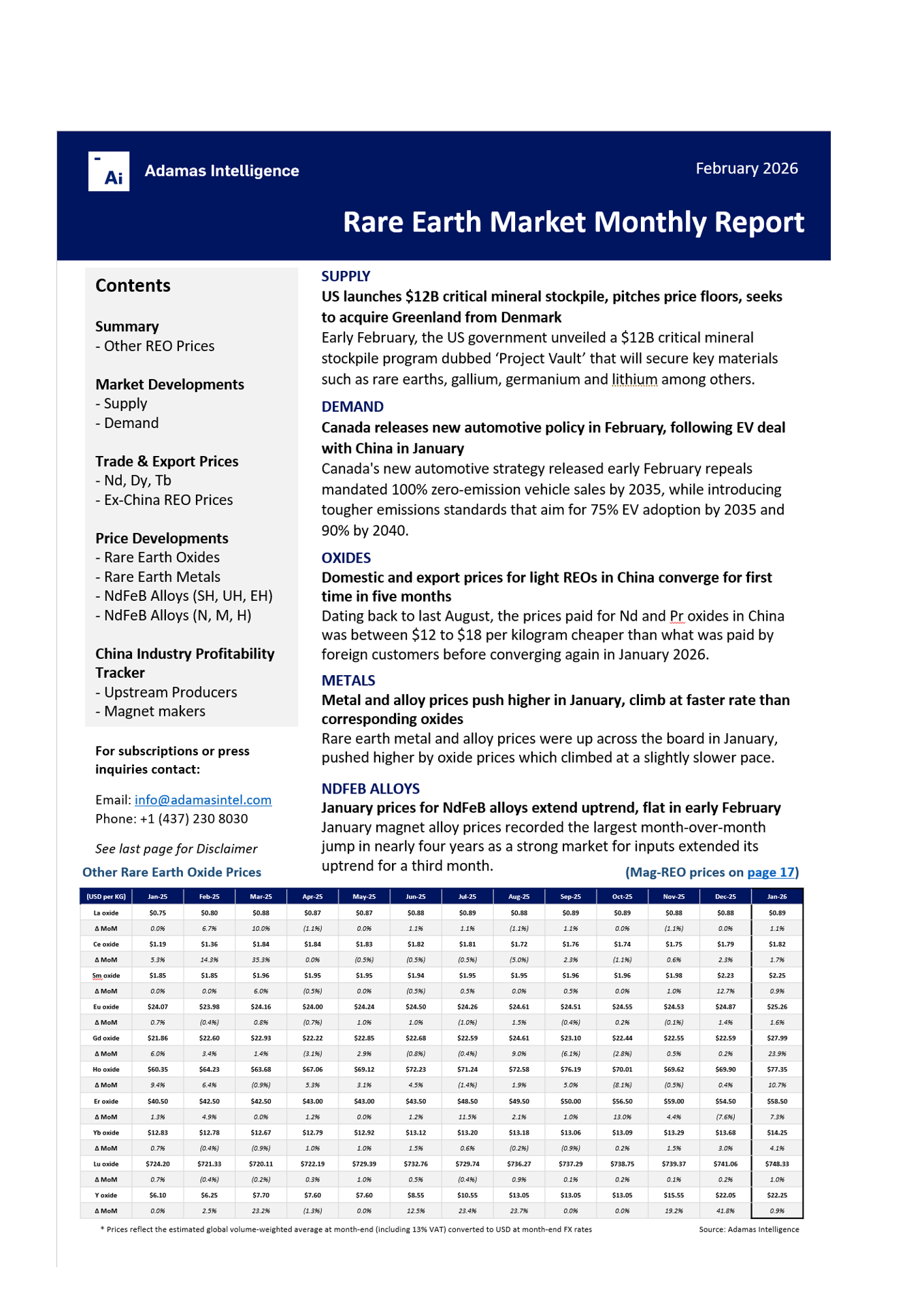
Rare Earth Market Monthly
Oxide, metal and NdFeB price assessments, market analysis and data
Potential for dysprosium and terbium prices to rally higher
While the exact duration of the closures remains unclear (some past episodes lasted months before partial reopenings), prolonged restrictions could persist if security issues worsen.
On the Myanmar side, that would limit access to China’s rice, cooking oil, vegetables and salt. On the Chinese side, however, it could limit vital access to Myanmar’s HREO-rich concentrates.
With China sourcing around one-third of its primary HREO feedstock from Myanmar last year (according to Adamas data), which it processes and manufacturers NdFeB magnets and other critical materials from, the nation is massively exposed to extended disruptions in the region that inhibit mine production and trade.
In late February, the Chinese government reportedly held talks with the KIA’s political interface, the Kachin Independence Organization (KIO), but details and outcomes remain unknown.
In the near-term, the latest border closures heighten global HREO supply risks – not just those of China – as scaled alternatives remain limited and add potential for dysprosium and terbium prices to surge higher, following in the wake of recent neodymium and didymium rallies.
Contact us today to learn more about Rare Earth Market Intelligence services.